
BEFORE YOU INVITE YOUR PEOPLE
Wedding invitation wording examples for twelve situations
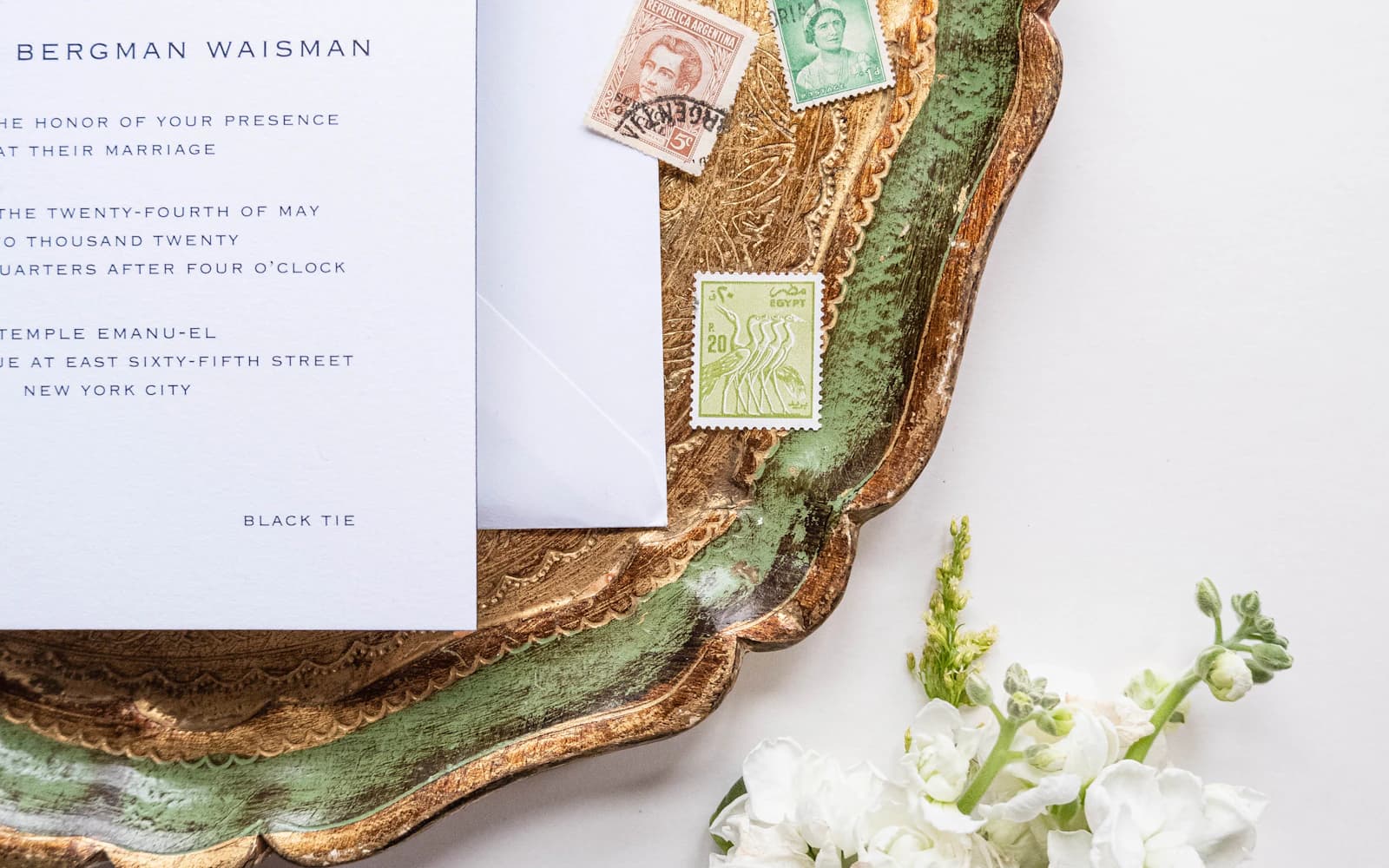
You’ve written the opening three times, and it still doesn’t sound like you. Wedding invitations can do that. Start with who’s getting married, when to come, and where to go. A sentence saying you’d love them there is enough.
Get the details straight first
Agree who the invitation is from: the couple, parents, or both families. Use the names they want on it.
Write the month in words and include the city. Give the ceremony and reception their own times, especially if they’re at different venues.
Check the version on the invitation image against the words you’ll send with it. Names, dates, venues, and arrival times should agree. A relative might save the picture and never return to the original message.
If your families use different names for the same function, give enough context for everyone to understand it. A short description and a time are often enough. Guests shouldn’t need to know your planning shorthand.
Choose the tone from the gathering
For a formal invitation, you might use “invite you to celebrate their marriage” and “kindly reply.” For a smaller gathering, “we’re getting married” and “let us know” can be just as complete. Pick the wording you’re comfortable saying.
The hosting line should reflect who’s inviting people. “Together with our families” works when that’s how you want to present the invitation. It isn’t a sentence you have to include just because other wedding invitations do.
If this is a second marriage, you don’t owe anyone an explanation in the invitation. Name the people getting married and invite your guests to the day you’ve planned.
Twelve ways to say it
Pick the closest example and change the words until they sound like you. Replace every bracket before sending.
The longer examples work as invitation wording. The short ones can be the message you send alongside a link. You can move the full schedule to the invitation page, but keep the date and enough context in the message for people to recognise it.
Use specific times for the parts guests are attending. “Dinner to follow” works if the plan is clear; separate times are more helpful when there’s a long gap, a change of venue, or guests arriving for the reception only.
1. Couple hosting
We’re getting married, and we’d love you beside us. Join [name] and [name] on [date] at [venue, city]. Ceremony at [ceremony time], followed by dinner at [dinner time]. Please RSVP by [deadline] at [invitation link].
2. Both families hosting
Together with their families, [name] and [name] invite you to celebrate their marriage on [date] at [venue, city]. The ceremony begins at [ceremony time], with dinner to follow. Kindly reply by [deadline] at [invitation link].
3. Casual
We’re getting married! Come celebrate with us on [date] at [venue, city]. Ceremony at [time], dinner at [time]. Let us know by [deadline]: [invitation link].
4. Formal
You are cordially invited to celebrate the marriage of [name] and [name] on [date] at [ceremony time], [venue, city]. A reception follows at [reception time]. Kindly RSVP by [deadline] at [invitation link].
5. Indian multi-event celebration
Join [name] and [name] for our wedding celebrations in [city]: mehendi on [mehendi date] at [mehendi time], sangeet on [sangeet date] at [sangeet time], and the ceremony and reception on [wedding date]. The full schedule and venue addresses are here: [invitation link]. Please reply by [deadline].
6. Destination wedding
[name] and [name] are celebrating their wedding in [city], and we would love you to join us. Ceremony on [date] at [ceremony time] at [venue], followed by dinner. Please read the travel details and RSVP by [deadline] at [invitation link].
7. Second marriage
We’d love you to join us as we get married. [name] and [name], [date], [venue, city]. Ceremony at [time], followed by dinner. Please reply by [deadline]: [invitation link].
8. Short and warm
We’re getting married! Join [name] and [name] on [date] at [ceremony time], [venue, city]. Your company would mean so much to us. Please RSVP by [deadline] at [invitation link].
9. Short reception-only
Celebrate with [name] and [name] at our wedding reception on [date], [dinner time], [venue, city]. Please join us for dinner and an evening together. Reply by [deadline] at [invitation link].
10. Short family welcome
Our families warmly invite you to [name] and [name]’s wedding on [date] at [venue, city], [ceremony time]. We look forward to celebrating together. Kindly reply by [deadline] at [invitation link].
11. Short intimate celebration
We’re having a small wedding, and we’d love you to be there. Join [name] and [name] on [date] at [time], [venue, city], with dinner to follow. RSVP by [deadline]: [invitation link].
12. Short WhatsApp message
Dear [guest name], we’d love you to join [name] and [name]’s wedding on [date] in [city]. Ceremony at [ceremony time]; reception at [dinner time]. Details and RSVP: [invitation link]. Please reply by [deadline].
Include the practical notes people need
For a destination wedding, give confirmed travel and accommodation details on the invitation page. Say which arrangements guests need to make themselves. Don’t let an inviting opening accidentally suggest that rooms or transport are included when they aren’t.
If there’s a dress request, explain it plainly. If part of the day is outdoors or involves walking, that detail can help guests choose what to wear. Include it when it applies, rather than adding a dress code for the sake of one.
Gift wishes can sit with the longer details if you have something agreed to say. They don’t need to take over the first message.
Make the invitation clear for each guest
If someone’s invited to the reception only, say that in their message. Name invited partners and say whether children are included. The link alone won’t answer those questions.
Keep meal questions with the RSVP. Your opening message only needs enough detail for someone to know what they’re being invited to and when to reply.
You can keep a shared opening while changing the guest names and arrival instructions. Read those parts before each send, especially when one person is invited to the ceremony and another is joining for dinner.
A link can be forwarded without your personal note. Make the main invitation clear, and ask relatives helping you share it to keep the names and event details in their message.
Give the reply request a full sentence
“Please reply by [date] at [invitation link]” is enough. Choose a date that leaves time to follow up before you confirm numbers. If the meal choices need an answer too, say so alongside the RSVP.
Add a contact for questions or changes. Someone whose travel falls through should know whom to tell, and you’ll want that change reflected in your numbers.
A reply request with food details
Please RSVP by [date] at [invitation link]. Include everyone attending in your party and give each person’s meal choice.
If plans change
If your plans change after you’ve replied, please message [host name] on [contact].
Frequently asked questions
Whose name goes first?
Choose an order you’re both comfortable with and use it consistently. Check the spelling before anyone forwards it.
Can I send everyone the same message?
You can use the same opening. Check the names, invited guests, and parts of the day in each message before sending it.
How much should I put in the WhatsApp message?
Include who’s getting married, the date, what the guest is invited to, and where to reply. Put the full addresses, schedule, and longer travel notes on the invitation page. Repeat important arrival instructions in the personal message.